
Finding Hudson County Residents
No single resident roll covers Hudson County. The county holds twelve separate municipalities, and each keeps its own records. A recorded property interest points to a county deed search. A current parcel question belongs to the municipality. An old household question usually belongs at the library. Always carry the municipality name through every step of the lookup. One surname or street can match convincingly in a neighboring Hudson community and still be the wrong family entirely.
Anchor the search to a fact that can be dated. An address opens a parcel and deed search. A full name plus municipality supports a court, voter-status, business, or license check. An older name calls for directories, newspapers, census material, and maps instead. Each source answers a narrower question than a full residents directory would. Comparing two independent records is what turns a lead into something solid.
- Write down the name variation, address, municipality, and approximate year before searching.
- Use a municipal tax source or the GIS map to obtain the parcel's block and lot.
- Search the Hudson Register's deed index by legal description or by grantor and grantee.
- Check the state voter-status route or court index only for the limited fact each system can confirm.
- For past households, compare a directory entry with a census, map, or newspaper image.
Note: A matching name, tax mailing address, or deed party is a dated lead, not proof of where a person lives in Hudson County today.
Hudson Resident Records Offices
Three offices anchor most Hudson resident research. The Hudson County Register holds the recorded land instruments, including deeds and mortgages. Municipal assessors supply some parcel fields. Statewide tax tools also tie an address to a legal description. Election officials administer voter records under their own separate rules. One distinction trips up many searchers: the county clerk is not the Register. Deed and mortgage questions go to the Register, not the clerk's counter.
Hudson County Register
257 Cornelison Avenue, second floor
Jersey City, NJ 07302
201-395-4760
Municipal Assessors and MOD-IV
Current parcel cards stay with the municipality.
Hudson County, NJ
Use the local assessor for the current card.
Hudson Election Offices
257 Cornelison Avenue, fourth floor
Jersey City, NJ 07302
Board of Elections: 201-369-3435
When a whole street matters more than a single person, the Hudson street directory route lines up the parcel, GIS, and deed sequence in address order.
Hudson Deed Index Paths
The Register's official recorded-instrument index is AcclaimWeb. Search modes cover Name, Book/Page, Instrument Number, Legal Description, Document Type, Consideration, and Record Date. A known block, lot, and municipality makes Legal Description the most direct path. That combination points straight to one address. An old or inconsistent address often works better through parties. Book and page, or instrument number, can work too. Spelling shapes the results, so run hyphen, middle-initial, and surname variants rather than one attempt.
A hit can name the parties and their grantor or grantee roles. It may also show document type, recording date, instrument number or book/page, legal description, and consideration where shown. The support guide documents filtering, printing, and CSV export. Remember that an index result is separate from a document image. Saving or printing details can depend on account permissions. The public site publishes no dependable online start year for the index itself.
Check the official Acclaim landing page before running a party or legal-description search.
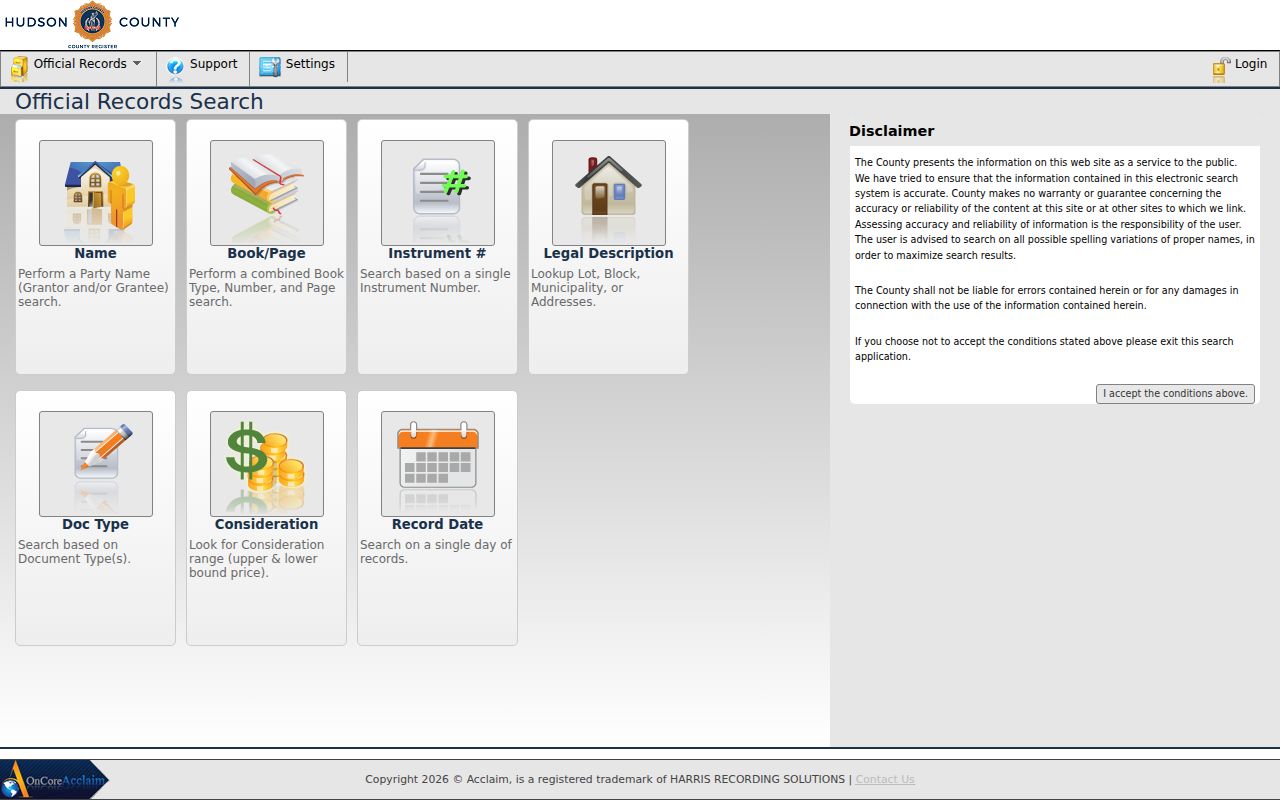
The index tabs are a useful reminder. When a street address alone fails, switch the search key. At the counter, the Register's search room holds deeds, mortgages, lis pendens, filed maps, and indexes, though photographs are prohibited there.
| Acclaim search field | Use in a Hudson search | Key limit |
|---|---|---|
| Name | Test grantor or grantee spelling variants | Exact visible subfields vary |
| Legal Description | Enter lot, block, and municipality | Address is not the legal description |
| Book/Page or Instrument | Open a known recorded reference | Requires the cited number |
| Document Type or Date | Narrow a party result | Does not establish occupancy |
Hudson Parcel Record Clues
New Jersey assigns assessment to municipal assessors rather than a county appraisal district. Start from the property location, sometimes called the situs, and pair it with the municipality. The NJ MOD-IV database is the historical property-tax source. Its data is described as complete from 1989 through 2024. It supports searches and downloads by year, municipality, block, lot, property class, address, and assessor attributes. Hosted owner names are redacted under Daniel's Law.
The annual tax list carries a time stamp of its own. Assessors submit records to the County Board by January 10 each year. A later change may never reach a certified list. Owner mailing address and physical location are different fields, too. A mailing address can point to a manager, a business, or an out-of-county destination. So it says nothing about who occupies the Hudson address.
The MOD-IV public search and download entry shows the historical property database. It sits behind this kind of date-aware comparison.
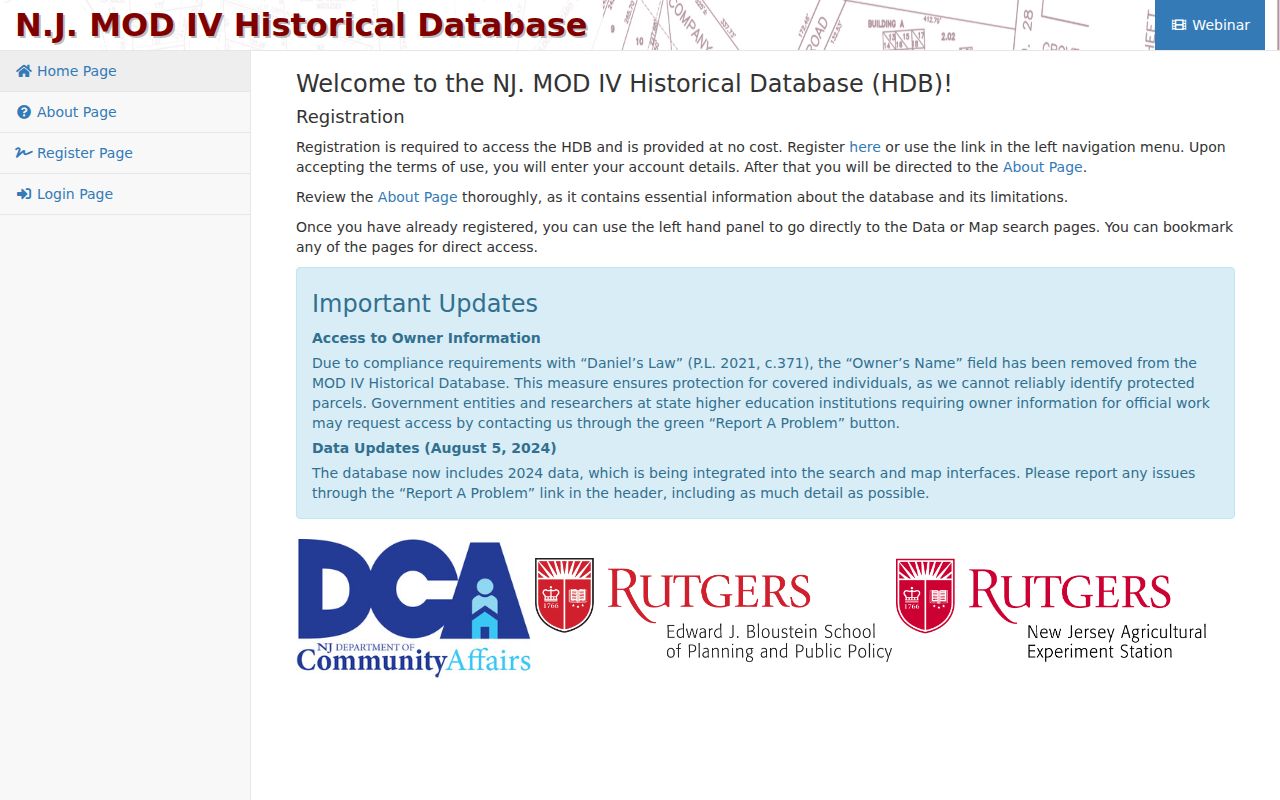
For stable research notes, record the parcel's block, lot, qualifier, municipality, and year rather than a copied owner name.
- Parcel
- A legally identified piece of property, usually located by block, lot, and sometimes a qualifier.
- Situs address
- The physical location of a parcel, distinct from the tax-bill mailing address.
- Index
- A finding tool that points to a record; it is not necessarily the record image or a certified copy.
- Resident roll
- A list connected to one purpose, such as registration or property, rather than a universal household list.
Hudson County Address Mismatches
Every Hudson County property record carries more than one address. A parcel has a situs, an owner mailing address, a postal city and ZIP, and a legal description tied to block and lot. Postal geography ignores legal lines. Harrison and East Newark both sit inside 07029, and Guttenberg and West New York share 07093. So a Jersey City label on a postal record tells you nothing about the municipality listed on a tax card or deed. Match the block and lot instead of trusting the mailing line.
Jersey City street numbers pose a second trap. Hudson City, Bergen, and Jersey City consolidated in 1870, and Greenville followed in 1873. The City Clerk keeps a street-number map open for inspection. A Historic Preservation Commission packet works a Warren Street case where old 101 and 103 became 215 and 217. Translate each number with the historic key, the maps, the deed parties, and the block and lot. One street's conversion never fits another.
Note: Hudson County formed in 1840 from Bergen County, so an early record may carry a Bergen County label on land that sits in Hudson today.
Current Hudson Resident Sources
Current sources earn trust because each one exists for a public job. A tax record or map pins down a parcel key. A deed index points to a recorded transfer. Voter status shows limited registration detail, while a court docket names a party and venue. None of them rolls up every current Hudson County resident, so treat each as one thread in the residents directory trail.
| Hudson source | What it can show | Custodian | Access boundary |
|---|---|---|---|
| Municipal tax card or MOD-IV | Parcel, tax year, assessed fields, possible owner field | Municipal assessor / state data | Current hosted names can be redacted |
| Acclaim deed index | Recorded parties and instruments | Hudson County Register | Index, image, account, and counter differ |
| Voter status | Limited registration status | State and county election offices | Not a public block roll |
| eCourts index | Party, venue, docket, and case date | New Jersey Courts | Case-type and privacy limits apply |
| License verification | Regulated credential and city | Consumer Affairs | Affiliation is not residence |
Matching a name is not matching a person. Before a Hudson resident lookup settles anything, weigh the dates, the municipality, and one more independent fact from the record.
Hudson Court Name Checks
New Jersey Courts Find a Case opens the statewide door to civil, criminal, judgment, tax, and municipal routes. The Hudson Vicinage handles the county's cases. The public eCourts training layout offers party-name, docket-number, and judgment modes. A party-name result can return a caption, venue, docket number, and initiation date. It can then link to a public jacket when one exists.
A docket hit is a lead, not a verdict. Check the venue and the party's role. Check the initiation date, and any filing the law makes public, against the rest of your records work. Juvenile, sealed, expunged, adoption, and protected family matters never show up as ordinary public name results. A blank screen may simply mean a privacy rule or a coverage limit.
The official court search keeps the state court paths separate from federal PACER.
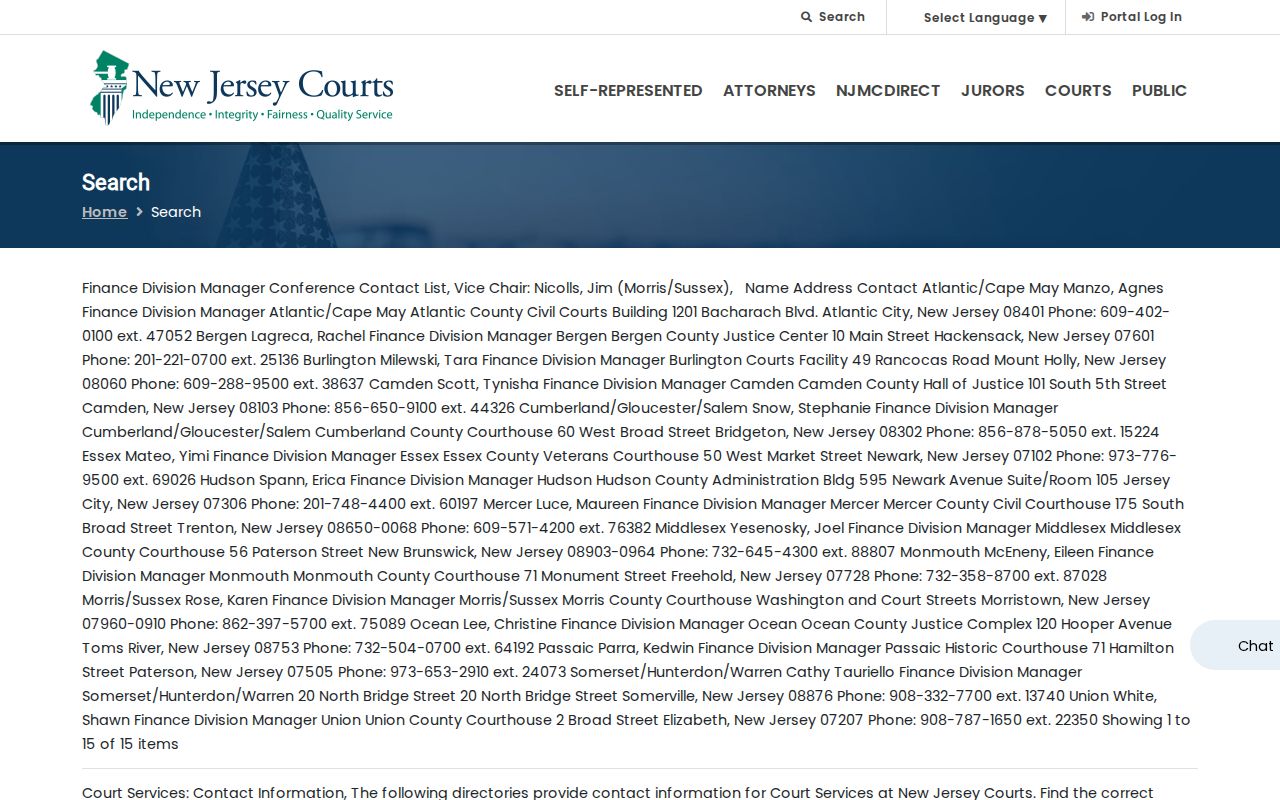
Need the papers themselves? Court copies move through JEDS, mail, or the proper office. Copy and certification rules differ by record type.
Hudson Vital Record Windows
New Jersey's modern vital records are not a public name index you can skim. The State Vital Statistics office holds births from 1925 onward plus marriages and deaths from 1951. Older series sit with the State Archives. Genealogy access opens after 80 years for a birth. It is 50 for a marriage and 40 for a death, under the state's conditions. For a current certified or certification copy, bring the right application and proof of identity. Bring relationship proof where required, and go to the correct custodian.
Ordering runs through the state, mail, VitalChek, or a local registrar that holds the event. Jersey City birth records go through the state route specifically. The state posts $25 for the first search, copy, certification, or no-record result. Other stated charges are possible. A certification is informational. A certified copy is the legal product with its own eligibility rules.
Use the New Jersey vital-record ordering page to pick the correct official path.
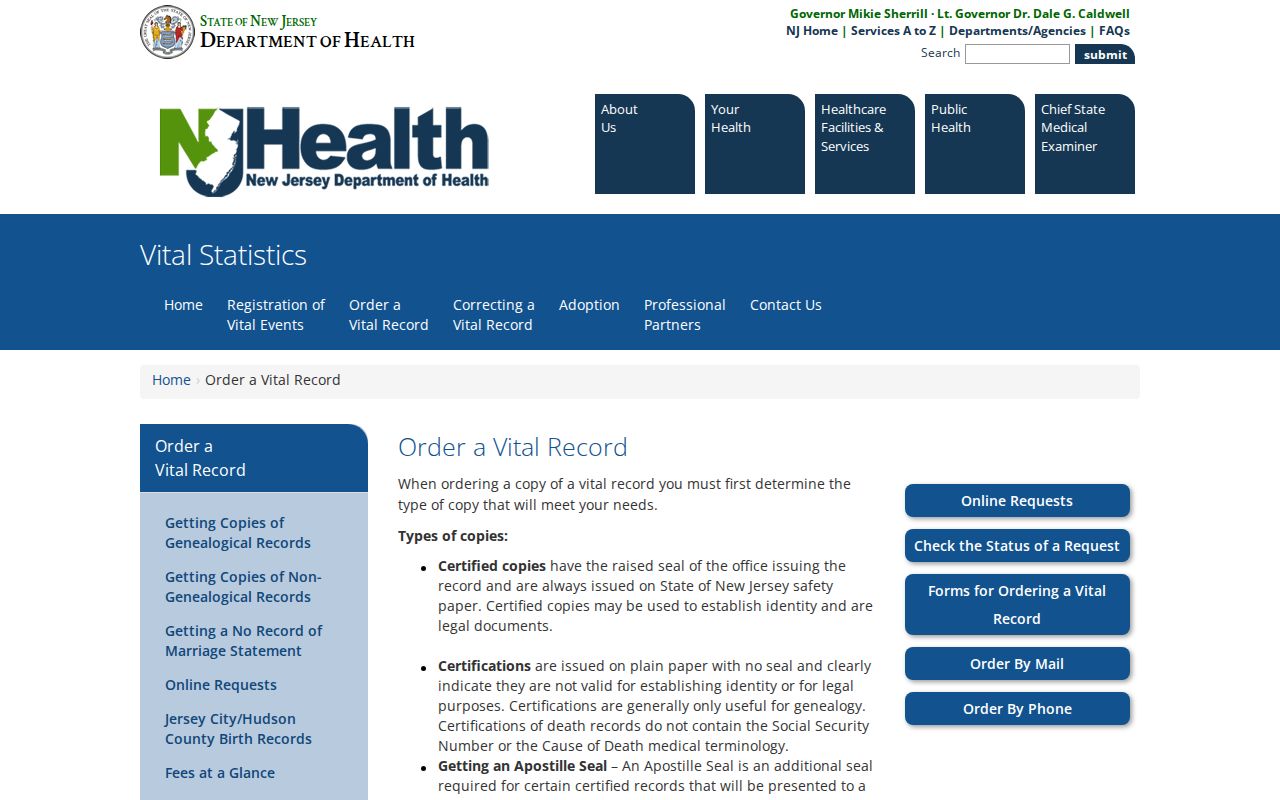
The state page splits genealogy, non-genealogical, and certified-copy paths apart. A date alone never picks the right request type.
Hudson Records Beyond a Portal
Online results often stop short of the full record trail. The Hudson Register's public search room at 257 Cornelison Avenue holds deeds, mortgages, lis pendens, filed maps, and indexes. The State Archives reports county deed microfilm through 1900. Its deed indexes often run later. It also points to FamilySearch digitization for county deeds. The Jersey City Free Public Library New Jersey Room stacks up directories, newspapers, maps, census film, and historical reference material. The Hoboken History Collection does the same.
For a government record that is identifiable but not online, New Jersey's Open Public Records Act, N.J.S.A. 47:1A-1 et seq., is the request route. Name the custodian, the record type, the municipality, the date range, and your preferred format. Inspection is free. The guidance lists standard paper copy charges. A normal seven-business-day response applies when a record is available. Jersey City takes OPRA requests through its online portal rather than fax or email.
The State Archives anchors the older Hudson County trail from its Trenton reading room at 225 West State Street, second floor. Appointments are recommended there when space is tight. Its collections include county deeds on microfilm through 1900. Deed indexes often continue later. The holdings also cover older mortgage and surrogate groups, plus Hudson Common Pleas naturalizations from 1840 through 1948. Copies can carry fees. Write down the source and date before weighing an archive finding against an online index.
Note: A focused request for one known instrument beats asking an office for everything about a person.
Historical Hudson Directory Shelves
The Jersey City Free Public Library special collections hold complete published Jersey City and Hoboken city directories from 1849 through 1925. They sit alongside roughly 20,000 volumes, more than 13,000 images, maps, topical files, and about 1,500 yearbooks. The New Jersey Room dates to 1964. It was built from Hudson County Historical Society and William H. Richardson collections. Its historical directories shine for a dated address. They also reveal an occupation, a spouse or widow notation, a school cohort, or a business lead.
Other Hudson County municipal runs are scattered rather than uniform. The State Library finding aid helps confirm a municipality and edition. Hoboken Public Library adds selected directory years, census microfilm, and Sanborn maps. The Hudson city directory collection page walks the shelf. It covers entry formats and household tracing in greater depth.
A 1925 directory is historical evidence, never a shortcut to where someone lives now. Pair it with the right census year. Add a newspaper image or a map before you conclude anything about a past resident.
Hudson Library Search Gaps
Hudson's historical record has gaps worth knowing about. The Jersey Journal index covers 1912–1954 and 1969 to the present, which leaves 1955–1968 unindexed. For those years, a resident lookup works better through newspaper scans, city directory volumes, court and deed records, yearbooks, and the library's topical files. The Library of Congress also hosts 5,339 digitized issues of the Jersey City News spanning 1889–1906. Check OCR results against the page image, though. Names and numbers split easily in old type.
Sanborn maps help with a house story. They can date a building's footprint, materials, use, or an old street number. They cannot name every occupant. A permit has the same limit. Jersey City's public permit and license search takes an address, record number, or keyword, and it can return a date, status, applicant, contractor, or inspection detail, but it is not a household list. Treat these tools as context for a street directory, not a substitute for one.
Note: In any Hudson records trail, keep a source date beside each finding and state plainly what the record cannot establish.
Hudson Privacy and Safety Limits
Some records will never fill a Hudson County residents directory, and that is by design. Protected voter addresses stay off public voter rolls. So do current vital records, motor-vehicle data, sealed or expunged court matters, and utility accounts. The same goes for non-owner household information. Safe at Home can supply a substitute address for qualifying participants. Daniel's Law shields eligible officials and their households. State parcel datasets redact owner names under those protections. An empty result in a resident lookup can simply be intentional.
Lawful use. Hudson public records support family history, estate work, neighborhood research, and verification of an official record. Do not use any record to stalk, harass, threaten, or harm another person. New Jersey's anti-stalking and harassment laws apply.
When an underlying record is wrong, take the correction to its custodian. Citing the tax year, docket number, instrument number, or application date makes the request much clearer. Commercial listings go stale or merge people with similar names, so they are no substitute for the official Hudson record trail.