
Hudson County Previous Residents Sources
A backward address trail needs more than one source. The deed chain identifies recorded interests, while a printed directory or census can show a household at a particular point in time. Maps help test whether the building and number fit the period. Start with the newest stable parcel information and work toward older records. Hudson County has dense municipal geography, so keep the municipality, postal label, block, lot, and any parcel identifier together. A shared ZIP or a repeated street name in another municipality can otherwise send the search to the wrong property.
| Source | Years It Covers | Where Held | What It Shows |
|---|---|---|---|
| Acclaim online deed index | Start year not published reliably | Hudson County Register | Recorded instrument index; confirm the cutoff |
| Hudson deed books and indexes | County deeds to 1900 on microfilm | State Archives, Register, and FamilySearch access | Older deed-chain route; image access varies |
| JCFPL directories | 1849–1925 | New Jersey Room | Named household or business and address clues |
| Federal and New Jersey census | Federal local list 1850–1920; state 1885–1915 | Libraries and archives | Dated household snapshot; 1890 federal census missing |
| Sanborn and permit sources | Map examples 1896–1950; permit start not stated | Library of Congress, Hoboken Library, municipal portal | Building context, work, and dated address leads |
Choose the first source by era. A recent address usually begins with municipal parcel data and the Register. An early address may need a directory, map, or archive before an online index can help. The Jersey Journal index is also a useful endpoint lead, but its listed 1955–1968 gap means a missing hit should be checked against other newspapers, yearbooks, and local files. Note: no single Hudson source proves every person who was physically present at an address.
Hudson County Previous Residents Parcel Keys
Freeze the address before searching names. Record the standardized street form, historic spelling, municipality, postal ZIP, block, lot, and parcel or PIN when available. New Jersey uses municipal assessors rather than one county assessment office. The local assessor, the statewide tax-list route, and NJ MOD-IV can supply a time-stamped property record. MOD-IV provides historical data from 1989 through information stated through 2024, but hosted owner names are redacted under Daniel’s Law. That makes the legal parcel key especially valuable when a name search does not return a usable result.
Keep the physical situs separate from a tax mailing address. The situs identifies the parcel location. A mailing address tells where tax correspondence was directed at that time and may belong outside Hudson County or to a representative. Then open the Hudson County GIS hub, select the subject parcel, and confirm its municipality and block or lot before moving to deeds. The map is planning and reference data, not a legal survey or official tax map. It is a bridge between the written address and the stable legal description.
| Situs | The physical street location of the parcel. |
|---|---|
| Mailing address | The tax-correspondence destination, which is not proof of residence. |
| Block and lot | The local legal parcel key used to connect map, tax, and deed records. |
| Qualifier | An additional local parcel identifier, often needed for a separate interest. |
Hudson County Previous Residents Deed Chain
Recorded deeds follow ownership interests, not a complete list of occupants. Use the parcel key in AcclaimWeb Official Records Search through its Legal Description mode, then test party names, book and page, instrument number, document type, consideration, and record date when the address does not match. The Register’s support material also describes filtering, printing, CSV export, and account-based image saving or printing. Capture the parties, their grantor or grantee roles, recording date, instrument or book and page, legal description, and image or account status.
- Confirm the current parcel’s municipality, block, lot, and legal description through the assessor or GIS route.
- Find the current recorded purchase using Legal Description, then record the seller, buyer, date, and instrument reference.
- Search the earlier seller as a grantee to locate that person’s purchase of the same parcel.
- Repeat the sequence, using party variants and book or instrument references when an old address is inconsistent.
- When the legal description changes, find the intervening deed or filed map that explains a split, merger, or revised lot.
- Grantor
- The party transferring a recorded interest.
- Grantee
- The party receiving that recorded interest.
- Chain of title
- The sequence of recorded transfers for the same legal parcel.
- Legal description
- The parcel wording that can remain useful when a street number changes.
Record limit. A deed records a transfer or interest. It does not, by itself, prove that either party was physically living at the property.
Hudson County Previous Residents Beyond Indexes
The web index is one layer, not the full deed file. The Hudson County Register property-search page directs researchers to Acclaim and to the public search room. The search room has deeds, mortgages, lis pendens, filed maps, and indexes at 257 Cornelison Avenue, second floor, Jersey City. Research and cashier hours are generally 9 a.m. to 2 p.m., Monday through Friday; the listed phone is 201-395-4760. The office does not publish a dependable online start year, and photographs are prohibited in the search room.
For older Hudson records, the New Jersey State Archives genealogical collections describe county deed books through 1900 on microfilm, deed indexes that often continue beyond 1900, and FamilySearch digitization for county deeds. Archives, office, online-index, and account-based image access are separate channels. If a chain stops online, search the office, Archives microfilm, or the permitted FamilySearch route rather than treating an empty online result as the end of the property story.
The State Archives genealogical collection search is the source for the archival route shown here.
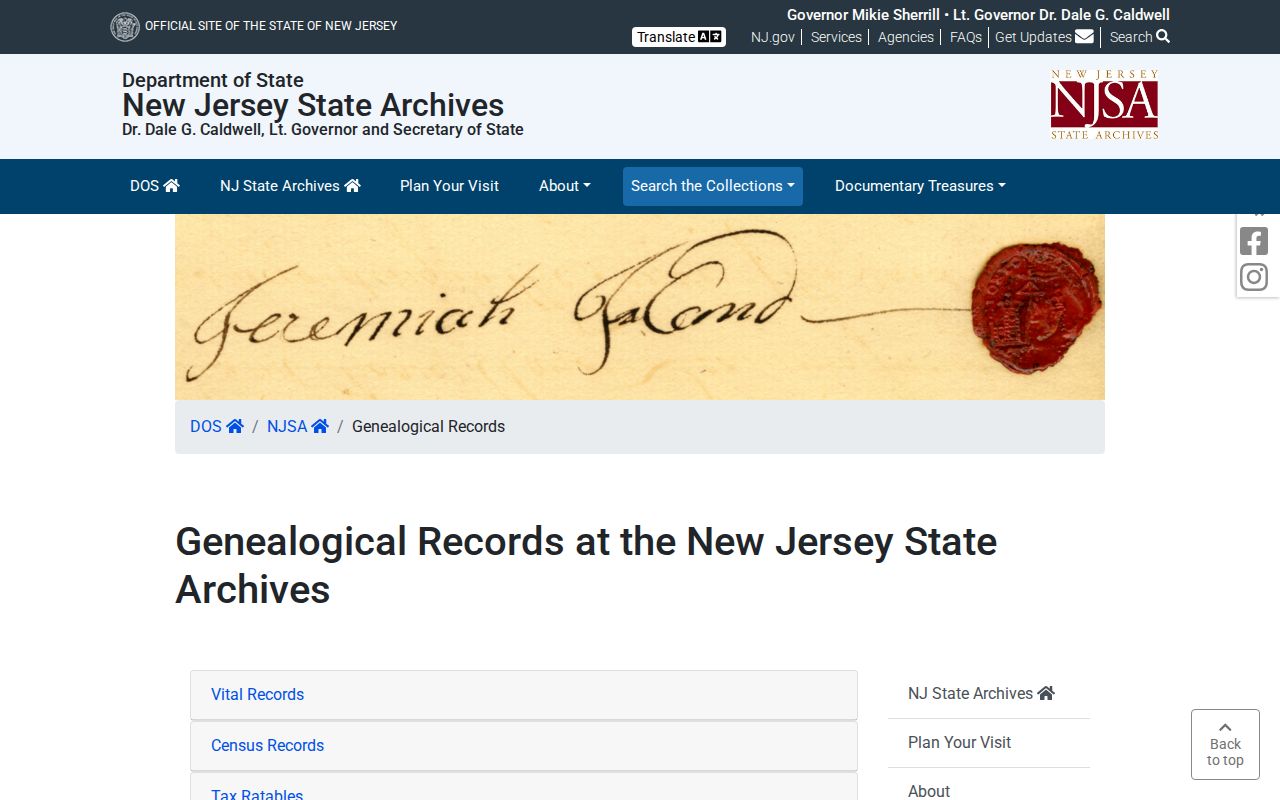
The archival collection list is a reminder to search the record layer that fits the period, especially when the current interface lacks an older index or image.
Old Numbers in Hudson County
Historic street numbers can make a sound deed or directory search look like a false negative. Jersey City’s preservation records give a Warren Street example in which old 1868 numbers correspond to later numbers through a specific key. Do not apply that example to another street. It shows why each old address needs a translation built from the actual key, a known adjacent property, a map, deed parties, and the legal description. Hudson City, Bergen, Greenville, and Jersey City also changed their municipal relationship during the nineteenth century, so a place name in an old volume may be correct for its date.
Jersey City’s building-numbering rules say the City Clerk keeps a street-number map or record open to public inspection. Use it when a current number, a map sheet, and an old directory conflict. Shorter address strings may also work better in the Jersey City permit search when historic abbreviations differ. For a current street-level records sequence once the translation is solved, the Hudson County by-street directory provides the address-keyed route. Note: old and current numbers should remain in separate columns until a dated source links them.
Hudson County Previous Residents Directories
Deeds reveal a recorded interest. Directories and census schedules help answer who was present in the household at a particular time. JCFPL holds published Jersey City and Hoboken directories from 1849–1925, while other Hudson community runs are scattered from 1884–1951. A reverse or criss-cross section, if the edition includes one, begins with the street and number before pointing to a named entry. The complete collection context and volume-reading method are kept with the Hudson County city directories rather than repeated here.
Use the household trail as a dated flow: address and municipality → reverse directory page → alphabetic entry → nearest census → newspaper or obituary check. A directory may omit people who were present, and a census may order a household differently. Compare street number, surname variants, family relationship, age, and nearby names before deciding two entries describe the same place. A printed entry is historical evidence, not a statement about anyone’s present location.
Lawful use. Hudson County house-history research belongs to family history, estate questions, and personal curiosity. Do not use an old record to stalk, harass, or track a living person.
Census Pairing for Hudson Addresses
Hoboken Public Library lists local federal-census microfilm for 1850, 1860, 1870, 1880, 1900, 1910, and 1920. The 1890 federal census is missing. New Jersey state censuses from 1885, 1895, 1905, and 1915 can fill some of the gap between federal decades. Match an address to the directory edition nearest in time, then test the household on the census date. A census has a broader household view; a directory has a different publication rule and may yield a street-specific clue.
Sanborn sheets add a physical date check. Research identifies Jersey City examples from 1896, 1911, and 1950, a Bayonne example from 1898, and Hoboken coverage listed for 1906–1938. A sheet can show a footprint, building material, number of stories, use, or street-number context. It cannot identify a complete household. The federal 72-year release rule also limits newer census-image access, so a later period may require a permitted archive or another dated record.
Hudson County Previous Resident Endpoints
When the address trail reaches a death, a transfer, or an unexplained departure, use endpoint records carefully. The Jersey Journal index has listed coverage from 1912–1954 and 1969–present, while Jersey City News at Chronicling America supplies 1889–1906 image, PDF, and OCR access. Obituaries can point to a date, a spouse, an executor, or an heir; probate may explain a later transfer. Verify OCR against the image and request probate material from the appropriate custodian when details are not openly available.
The Hudson County Genealogical & Historical Society offers collection, database, research-tool, and help-center entry points. Its public material does not set a single fee or research-service menu, so send a targeted request with the surname, municipality, year, street, and question. That is more useful than asking for a broad search of a whole neighborhood.
The Hudson County society homepage is the source for these research tools and collection leads.

Use a society resource to locate a collection or obtain advice on a narrow historical question, while retaining the original dated record as the evidence for an address conclusion.